
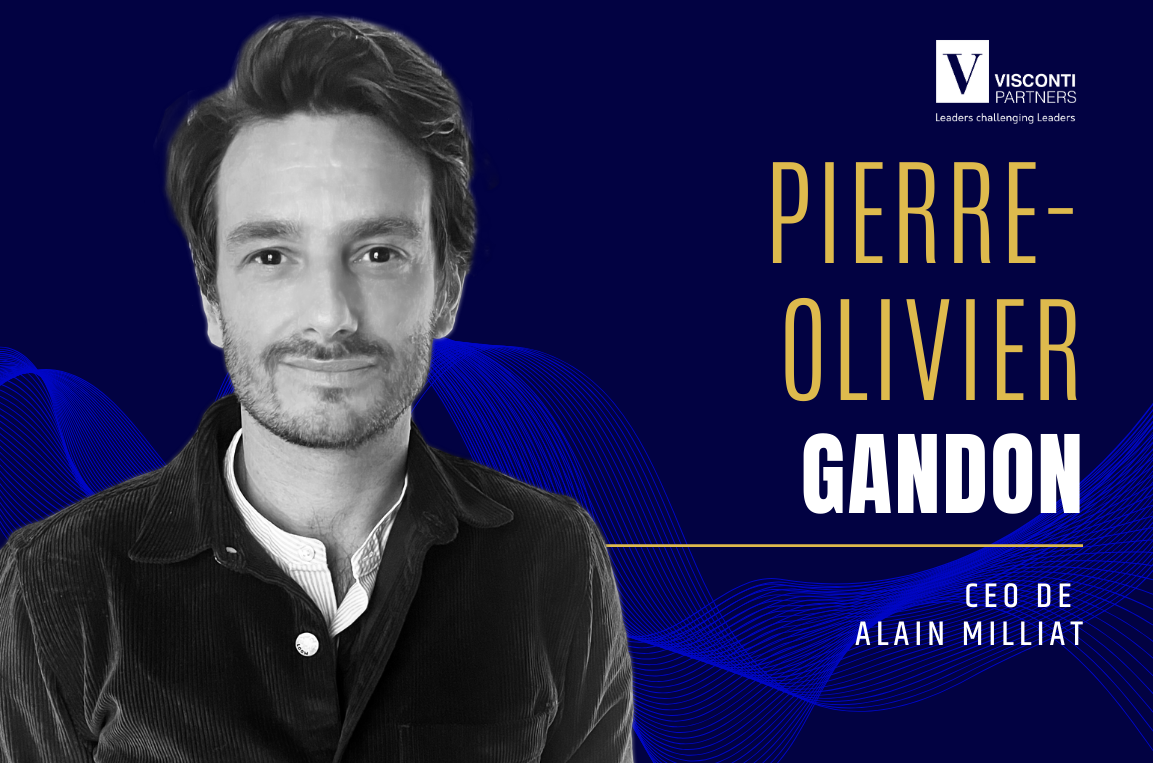
Pierre-Olivier Gandon, CEO of Alain Milliat, guest of Xavier Guérin
In this episode of Visconti Talks,
Xavier Guérin welcomes Pierre-Olivier Gandon, CEO of Alain Milliat, for an in-depth conversation around a question many leaders ask themselves… without always answering it clearly:
What is a leadership team really for?
And above all, how can it become a true lever for transforming both the leader and their teams?
The leadership team: far more than a formal body
At Alain Milliat, a French premium beverage house renowned for its uncompromising standards and positioning, the leadership team is neither a rigid ritual nor a mere rubber-stamping body for decisions already made.
It is conceived as a living space, where information genuinely circulates, where decisions are built collectively, where strategy is aligned with operational reality, and where execution follows intent. A place where functions engage in dialogue, challenge one another, and give meaning to the direction set.
Pierre-Olivier Gandon explains how establishing the leadership team marked a shift from an intuitive form of governance, strongly embodied by the founder, to a more structured model, without sacrificing the agility or high standards that define the company’s DNA.
Deciding together: the heart of performance
The episode takes a deep dive into what truly makes a good decision within a leadership team.
Not a decision driven by instinct alone, nor by endless debate, but one born from a subtle balance between facts, indicators, experience, and the leader’s intuition.
Constructive challenge plays a central role here, not as sterile opposition, but as a driver of clarity and sound judgment. Conversely, Pierre-Olivier Gandon highlights familiar pitfalls: deciding too quickly out of urgency, deciding too late at the risk of exhausting teams, or multiplying projects to the point where collective energy and execution become diluted.
The invisible indicators of a high-performing leadership team
Beyond numbers and financial results, certain signals never lie.
A high-performing leadership team can be felt in the energy at the end of a meeting, in the quality and balance of contributions, in the ability of members to express disagreement without fear, and in the way this energy then flows through the organisation.
When the leadership team works well, its impact extends far beyond the meeting room. It becomes a reference point, a source of stability, almost a cultural engine for the entire company.
Leadership posture: from expert to conductor
This episode highlights a key principle in executive coaching:
the performance of a leadership team begins with the transformation of the leader themselves.
Pierre-Olivier Gandon speaks candidly about what he had to unlearn: not always having the last word, resisting the urge to add value where the collective can create more, allowing less dominant voices to emerge, and acknowledging fatigue, mental load, and even vulnerability.
He describes his role as that of a conductor, capable of stepping back so the orchestra can play in harmony, accurately and sustainably.
Key takeaways from this conversation
A leadership team is truly effective when it creates harmony through constructive challenge.
Sustainable performance comes not from strategic perfection, but from execution carried by teams.
The human quality of the leadership collective is a key factor in resilience and growth.
And when used well, the leadership team becomes a genuine collective coaching tool — serving the transformation of both the leader and the organisation.
What next?
What if you took a moment to question what your leadership team really produces, beyond formal decisions?
What if you worked on the quality of dialogue, challenge, and psychological safety?
What if your own leadership posture were the first lever to allow the collective to fully take its place?
An episode for executives, leadership team members, and executive coaches who want to go beyond assumptions and turn their leadership team into a true driver of collective performance.


%20(2)%20(2).png)



.jpg)
.png)
.png)