
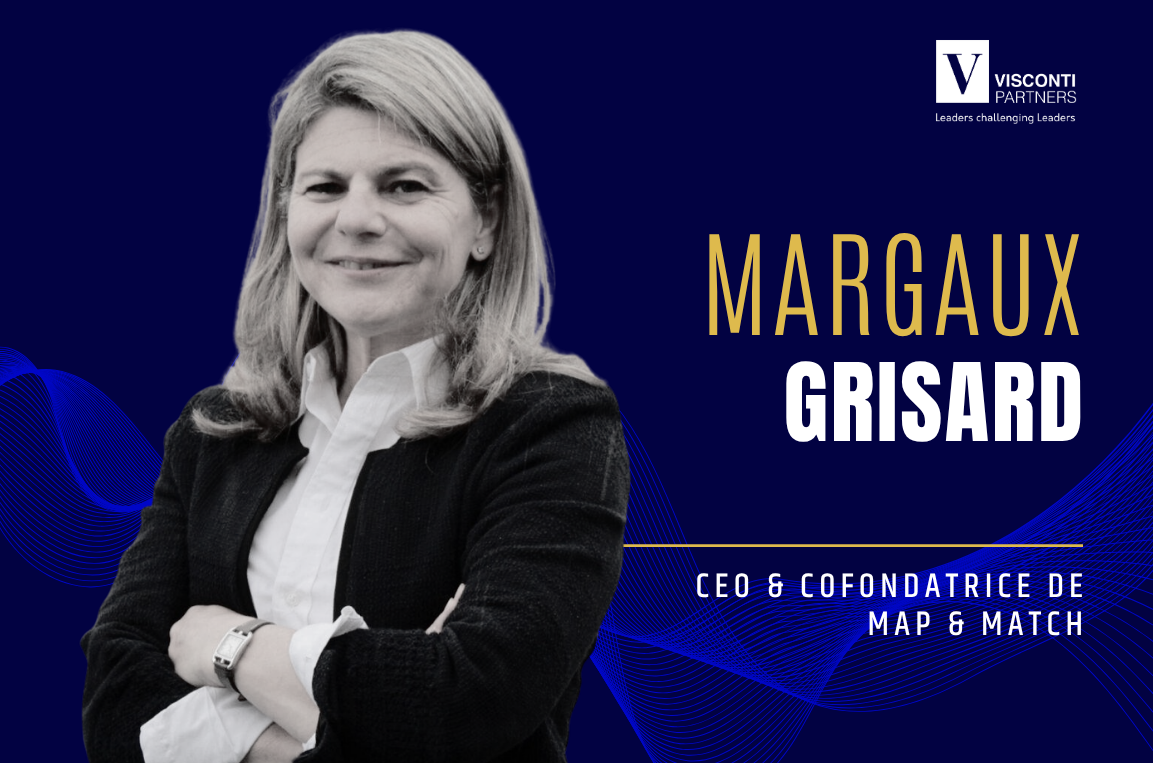
VISCONTI Talks with Margaux Grisard, CEO and co-founder of map & match, in conversation with Tanguy Delamare, Partner at VISCONTI.
"Competence and engagement don't always go hand in hand."
You hired the best. On paper, your executive committee is beyond reproach. And still, it isn't clicking.
Margaux Grisard lived that gap before she built a company around it. She talks about it plainly in this new episode of VISCONTI Talks.
The paradox almost every leader has already faced
The figure is stark. In France, 8% of employees describe themselves as engaged at work, against a European average of 12% and a global average of 20% (Gallup, State of the Global Workplace 2026).
This is not a competence problem. Competence has never been so thoroughly assessed, measured and certified.
It is an energy problem.
Who is Margaux Grisard?
She comes from finance. She knows performance.
But she describes finding herself, more than once, in front of teams that were objectively very competent and simply weren't delivering against expectations.
She co-founded map & match in early 2016, around a project to transform the HR function at Sanofi France. Her conviction is simply put: when you look at a company's assets, the figures aren't what you should be looking at — the people are.
What is map & match?
A SaaS platform. And a conviction: it is possible to reconcile employees' energy with the economic and commercial demands of the business.
The shift in paradigm comes down to a single word.
We stop talking about competences — knowledge, know-how, interpersonal skills. We start talking about appetences — what you like doing, what you want to do, what gives you energy.
map & match calls these Energy Skills™.
At the heart of the platform sits a model drawn from twenty years of research. It identifies 5 major functions — initiating, delivering, enriching, steering, connecting — each broken down into four sub-functions. That makes 20 sub-functions, presented as the keys to the sustainable performance of any system: a company, a team, a project.
The model was developed by Chantal Gensse, co-founder and scientific director of map & match, a doctor in systems theory and a former CNRS researcher.
Competences, behaviours, appetences: are they really complementary?
Yes. And Margaux Grisard says so without hedging.
You cannot dismiss technical competences. You cannot dismiss behavioural ones either.
But engagement doesn't rest on competence alone.
She offers an example any executive coach will recognise: leaders who are perfectly competent, who have lost the appetite, and who can no longer take their company to its next stage.
Competence plus engagement: not enough. Competence plus sustainable performance: not enough either.
It is an additional lens. Not a competing one.
Who is the tool for: the CEO, the leadership team, or HR?
All four, but for different reasons.
- CEOs and managers: they carry the burden of aligning people with business objectives.
- Executive and leadership committees: this is where, in her view, the tool has no real equivalent — on collective dynamics.
- HR teams: recruitment, internal mobility, succession planning, identifying tomorrow's managers.
- Coaches and consultants: change management, individual support, building project teams.
In one-to-one coaching, she notes, behavioural tools already exist. The lens is there, but it isn't sufficient on its own — and the coach's expertise does the rest.
On collective dynamics, the contribution is different: revealing a team's own intelligence and aligning it with what the team is being asked to achieve.
How does the platform actually work?
The MAP is the mapping stage.
- A 15-minute online questionnaire.
- One single question: "I take more pleasure in…"
- An algorithm built over several years of R&D.
- No good or bad profile. It isn't a test. It is self-knowledge.
The MATCH puts that against reality.
A library of roles translated into Energy Skills makes it possible to compare a profile with a position, a team with its objectives, a manager with their team. Or, working the other way round, to start from a role and identify the people likely to find their energy in it.
A final application composes complementary teams — used in particular when assembling project teams.
What does the read-out reveal? Three levels of energy
A MAP surfaces three levels, whether for an individual or a group.
- Deep talents. The pillars. They shift little over time.
- Complementary talents. Activatable potential.
- Inherents. What costs energy.
An inherent isn't a no-go. It is a warning signal.
Margaux Grisard quotes a formula from a VISCONTI coach that she now uses readily:
"Where there is no appetence, you have to double down on competence."
If the role demands an appetence that isn't there, it will have to be compensated. Through process. Through a system. Through complementarity.
The graphic read-out is simple. And above all, it establishes a common language inside the company — free of judgement, since there is no wrong profile. Managers end up talking about talents as a dynamic to activate, or not, depending on the moment.
Use case 1 — Private equity: aligning the leadership team with the investment thesis
The context has shifted. Bain & Company sums up the new equation in a phrase: "12 is the new 5" — deals that once delivered competitive returns on modest EBITDA growth now require sustained, double-digit growth. In other words: value creation now hinges on operations, and therefore on teams.
That is precisely where map & match comes in.
A growing number of funds now offer it to their portfolio companies, sometimes pre-deal, more often post-deal, in order to:
- translate the investment thesis into Energy Skills and examine the leadership team's collective dynamic against it;
- make both strengths and points of vigilance explicit;
- build an action plan, tracked like any other plan reviewed at board level.
The typical sequence: each member of the leadership team completes their profile, then has a one-to-one debrief with a certified practitioner — an operating partner from the fund, an external consultant, a partner. Then a collective session. Then a check-in one or two months later.
The collective session builds team spirit. But Margaux Grisard is clear: team spirit alone doesn't produce performance.
"The best team isn't necessarily the team of the best. It's the team that lets each person hold their best role within a shared objective."
The point echoes what Bain has long observed across portfolio companies: private equity professionals overwhelmingly agree that waiting too long to adjust the management team is paid for in underperformance.
Use case 2 — A turnaround in a sector under strain
A leader takes over as chairman of a group of care homes. A sector in crisis: financial fragility, heavy reliance on public funding, real difficulty recruiting and retaining people.
He arrives with a turnaround to deliver and a strategic plan to roll out.
His request to map & match is precise: look at the top 250 in France and the top 100 in Belgium, and identify those who combine leadership, an appetite to deliver, and an appetence for change.
Not to cherry-pick. To put energy back into the organisation, and to spot those who needed more support.
The data was then connected to the sector's four performance capillaries:
- occupancy rate;
- profitability;
- satisfaction among families and residents;
- employee engagement.
The most telling finding fits in a single line. The finisher talent has a strongly positive impact on family and resident satisfaction. And a damaging one on profitability.
No single person can therefore carry all four indicators. It is a shared responsibility.
What followed:
- support across 170 sites, so that directors could work in complementarity within their own leadership teams;
- a recruitment plan, with the talents to look for defined function by function — leaving the company self-sufficient on that front;
- a regional reorganisation and the resulting internal mobility moves;
- the business returning comfortably to break-even;
- and today: a programme for high potentials.
Can a leader be afraid of the result?
The question is worth asking. And the answer is honest: yes, that fear exists.
It stems from a misunderstanding. The questionnaire is often taken for a test — when there is no good or bad profile.
The debrief is what dispels it. A first, partial read-out, then a one-to-one conversation that also covers the irritants, with a deliberately educational intent.
In practice, though, the fear is rare. Because a leader who deploys this kind of tool is thinking about their objectives first, not about themselves.
What VISCONTI Partners has taken from it
VISCONTI has deployed map & match across a range of leadership teams and companies — start-ups as well as mature businesses.
Three observations come back consistently:
- a visual read-out that is simple and readily understood by whole teams;
- terms and appetences that are highly operational;
- the ability to move quickly to concrete action.
That last point matters most in our work with leadership teams: getting from diagnosis to decision, fast.
What to take away from this episode
- Competence guarantees neither engagement nor sustainable performance.
- Performance is collective first, and the collective rests on complementarity — not on stacking up individual excellence.
- Appetence is data, not a feeling. It can be mapped, matched to a role, and connected to KPIs.
- Inherents are not flaws. They are points to offset through process or through the collective.
- The real deliverable is a common language. Free of judgement, it changes how a team talks to itself.
Margaux Grisard closes on an image drawn from sport — map & match's first beta testers were elite athletes:
"A team that gets on very well in the changing room won't necessarily win the match. On the pitch, it's each person in their role, in complementarity, facing a shared objective."
Getting from the changing room to the pitch. That is exactly the work we do with leadership teams.
FAQ
What is the difference between competences and appetences? Competences describe what you are able to do. Appetences describe what you like doing, what gives you energy. Someone can be highly competent at work that drains them. That gap explains a good share of disengagement.
What are Energy Skills™? It is the term map & match uses for talents tied to the pleasure of doing. The model identifies 20 sub-functions across 5 major functions: initiating, delivering, enriching, steering and connecting.
How long does the questionnaire take? 15 minutes online, built around one question: "I take more pleasure in…". There is no good or bad profile.
What does the mapping give a leadership team? It makes the collective's strengths and points of vigilance explicit against a shared objective — an investment thesis, a strategic plan, a transformation — and then supports building an action plan and tracking it over time.
Why can a competent team underperform? Because collective performance depends on how roles complement one another, not on the sum of individual talent. A team can be excellent and badly distributed.
Is your leadership team aligned with what you're trying to achieve? Let's talk — our coaches are former leaders themselves.
Sources
- Gallup, State of the Global Workplace 2026 — France Country-Level Data, April 2026 — https://www.gallup.com/workplace/705338/state-global-workplace-france-country-level-data.aspx
- Bain & Company, Global Private Equity Report 2026 (press release), February 2026 — https://www.bain.com/about/media-center/press-releases/2026/private-equity-resurgence-gathers-steam-as-new-era-challenges-firms-to-enhance-value-creationbain--company-global-pe-report/
- Bain & Company, Portfolio Company Talent Decisions: A Left-Brained Approach — https://www.bain.com/insights/talent-decisions-global-private-equity-report-2021/
- map & match, platform and Energy Skills™ overview — https://mapandmatch.com/plateforme/
- RH Matin, interview on the scientific model behind map & match (Chantal Gensse, doctor in systems theory, former CNRS researcher) — https://www.rhmatin.com/qvt/motivation-engagement/map-match-les-talents-innes-sont-peu-exploites-en-entreprise.html
- Supercollaboratif, profile of Margaux Grisard, co-founder and CEO of map & match — https://supercollaboratif.com/actualite/margaux-grisard-ceo-co-fondatrice/
Everything else in this article comes from the episode transcript.

Tanguy DELAMARE
“The pessimist complains about the wind, the optimist waits for the wind to turn, the leader adjusts the sails.” John Maxwell


%20(2)%20(2).png)



.png)

.jpg)
.jpg)