|
Resources
|
|
|
Managerial innovation at the heart of business strategy
.png)
While for some, it is only a “craze for CEOs” (55%) and for others “a way of promoting well-being” (40%), for 64% of respondents, managerial innovation is proving to be a “means of improving the economic performance” of a company (survey BVA Audencia 2017).
These figures clearly show how different perceptions of managerial innovation are.
However, the obvious is emerging: in a context where the labor market is being shaken up by artificial intelligence, the massive exploitation of data, new technologies and a profound transformation in the relationship with the work of employees, inventing new ways of managing seems more essential than ever to allow a company to remain competitive.
Therefore, a key question is needed:
How can managerial innovation influence a company's strategy?
In other words, what benefits can businesses expect?
Before answering it, it is necessary to clarify what this concept of managerial innovation really covers, and then to look at the practices and methods that nourish it.
And to better understand their scope, we will finally come back to some concrete examples of managerial innovations by companies that have drawn convincing results.
If we regularly mention the innovation management as a source of performance, managerial innovation refers to a new way of considering the role of manager within a company.
This is another expression of innovation, but one that is just as influential on a company's performance.
This new approach to management is not limited to a simple adjustment of the methods of managing a business, but is based on a profound transformation in the way of leading and collaborating.
The idea is to create an environment where managers and employees work together in a different way, with the common goals of individual development and collective performance.
In practice, managerial innovation, which in its intention meets the transformational leadership, is structured around three axes:
Managerial innovation brings major benefits to businesses.
Beyond the modernization of practices, it acts as an accelerator of economic performance and productivity, but also of team commitment and loyalty.
What are the many benefits that an organization that has chosen managerial innovation can expect? The point.
Companies that focus on managerial innovation often see a significant increase in their performance, thanks in particular to better employee engagement:
At a time when retaining talent is a real problem, the adoption of new management procedures offers many sources of satisfaction. However, a happy and successful employee is generally loyal.
Reinventing management is not limited to integrating new tools: it is above all a profound change in corporate culture.
By focusing on transparency, collaboration and autonomy, companies create a favourable environment for collective performance.
All of the capital gains mentioned above play an active role in promoting:
Studies and surveys confirm this: managerial innovation has become essential for any company that wants to remain competitive on a global scale.
But turning to managerial innovation to comply with the trend, to copy competitors or to comply with company injunctions leads nowhere.
A managerial innovation approach can only work if it is based on genuine conviction :
put the human at the center and recognize all forms of intelligence.
To succeed, this dynamic must be rooted in the company's own culture.
Managers then have a key role in this transformation: they must understand the challenges, lead the change with conviction and set an example on a daily basis.
Managerial innovation cannot be decreed, it is not a miracle recipe, a list of theoretical recommendations.
Moreover, according to a study by the Harvard Business Review, seven out of ten managerial innovation initiatives fail because they are poorly implemented.
In other words, the challenge is not to “decree” innovation, but to embody it step by step.
It is a continuous process of adapting and improving managerial practices, which must be designed according to the specific culture of each company and its strategic objectives.
As mentioned above, to remain competitive, businesses need to reinvent how they operate.
Traditional management models, long focused on control and hierarchy, are now showing their limits in the face of new employee expectations and the challenges of a constantly changing world.
It is in this context that new approaches to managerial innovation are emerging that are more human, more agile and better adapted to current realities.
Here are five particularly popular ones.
Far from the rigid hierarchical management model of the” Command & control ” which once dominated, agile management emerged in the 2000s and is now establishing itself as a reference during the digital transformation of companies.
Indeed, this approach puts people back at the center of the organization.
It values motivation, autonomy and well-being at work.
It is based on a open collaboration between all project stakeholders — directors, CEOs, teams, but also customers.
This mode of operation encourages flexibility and the ability to adapt, by giving priority to continuous evolution rather than strict compliance with fixed processes.
Its benefits are numerous: faster and regular deliveries, a culture of innovation, increased team engagement, reduced turnover and better adaptation to the new challenges of remote work.
Frugal management offers another path, that of a sustainable managerial innovation strategy which takes into account economic and ecological constraints.
It is not a question of doing less, but of doing better with limited resources.
This approach aims to stimulate collective creativity in order to design solutions that are effective, accessible and economical at the same time.
It is based on six key principles:
Research in neuroscience, psychology, and brain imaging clearly shows that our mental state at work directly influences brain activity.
Neuromanagement relies on these discoveries to rethink the way teams are managed.
The objective is simple: to reduce stress, create a healthier work environment, develop creativity and strengthen collective well-being.
In contrast to toxic management, it consists in better understanding our own cognitive mechanisms and those of others in order to stimulate memory, motivation and the quality of decisions.
The manager's role has changed profoundly: he is no longer limited to distributing tasks or monitoring results.
Today's manager acts like a coach.
He encourages, develops skills and helps his team to progress while staying focused on strategic goals.
This management style promotes commitment, loyalty and shared success: when employees succeed, the manager also comes out on top.
With the rise of so-called “liberated” companies, we sometimes hear that management is living its last hours. In reality, it is not the function of manager that is disappearing, but his authoritarian and directive style.
Modern organizations prefer more horizontal structures, where teams have a large degree of autonomy.
Thanks to his detailed knowledge of the workings and strategic vision of the company, the manager no longer orders: he accompanies, he supports, he facilitates.
Her role is to help her colleagues make quick decisions, dare to come up with ideas and innovate.
He no longer places himself above, but at the side of the team.
This approach empowers employees, limits unnecessary controls and fosters a climate of trust, which reinforces both performance and job satisfaction.
Among concrete examples of the success of managerial innovations, there are some famous ones:
But in addition to these famous examples, it is just as interesting to look at paths closer to the daily life of businesses.
This is the case of the entrepreneurial adventure of Bertrand Barré, CEO of the Zebra group, leader in innovation and design consulting in France.
A former top athlete, he has transposed his experience into the business world by adopting a coaching position with his teams.
For him, mastering innovation processes is not only a tool for creating value, it is also a true management philosophy.
Thus, rather than relying on a classic pyramid management model, he chose to organize his company into small autonomous teams, thus promoting direct and more fluid exchanges with management.
However, Bertrand Barré underlines that such a transformation cannot be improvised and requires appropriate support, such as the one he himself received.
His testimony can be found in podcast illustrates in a concrete way how management focused on innovation can breathe new life and efficiency into an organization.
These examples clearly show how innovative management can transform an organization. By thoroughly revolutionizing the role of managers with employees, companies can improve both their performance and the motivation and satisfaction of teams.
If you are looking to shake up your habits and enrich your vision of management, reading is a great starting point.
The work of Francis Boyer, or the analyses published in Harvard Business Review and Academy of Management Review, offer valuable insights on this theme.
Birkinshaw and Mol, for example, studied how managerial innovation improves both team satisfaction and performance.
Likewise, do not hesitate to take inspiration from the books of David Autissier, who has carried out an important amount of research on managerial innovation and the construction of collaborative models.
So, in his book Managerial innovation which he co-authored with Kevin Johnson and Jean-Michel Moutot, he reviews several very inspiring managerial innovation techniques: co-development, co-design or even learning networks to name only the main ones.
Technology can also become a real ally. According to Gartner, nearly 9 out of 10 companies that use project management software are seeing better collaboration between their teams.
Platforms like Notion, Trello or Asana not only make it possible to better organize work, but also to promote the exchange of ideas and more fluid communication.
Many universities and schools offer continuing education programs dedicated to managerial innovation.
But beyond traditional training, individual or group coaching offers a more concrete approach.
It helps managers adopt new postures, experiment, and find their own style.
Do you also want to innovate in management and take on the role of coach or encourage your managers to evolve in this direction?
Several questions should be asked of you.
How to communicate on this managerial innovation?
How do you keep employees motivated?
How to change your role from manager to that of coach?
A multitude of perfectly legitimate questions at the dawn of a change in management.
To support the transformation and allow your managers to invest in this innovation, professional coaching is a good option.
This is even more the case with Visconti Partners, since support is based on a lived experience : the Coaches are former CEOs who have themselves led projects to transform the management of their companies.
Their mission today is to share their know-how and to transmit concrete methods to help other leaders to innovate in their management.
Do not hesitate to contact our team to discover how our manager and executive coaches can support you in your business management innovation.
Visconti Partners presents its advice, inspiration, and case studies to help you unlock your potential and that of your business.
View all articles

What keeps a company standing isn't always what you'd expect. A cross-reading of biology and management on executive robustness.
%20(2)%20(2).png)


For Louis Godron, the role of majority shareholder is to be a supporter and a catalyst for transformation in companies. The...
.png)
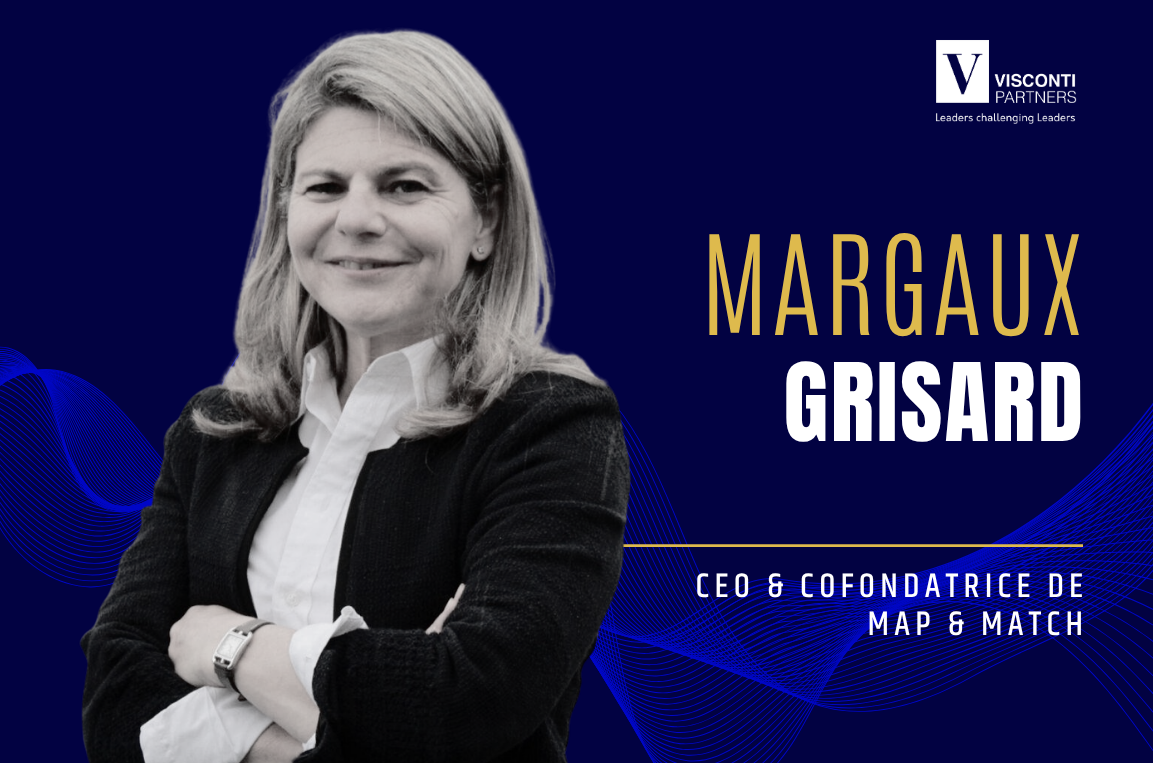
You hired the best, and still it isn't clicking. Margaux Grisard, CEO of map & match, explains why competence no longer produces sustainable performance on its own — and how mapping a leadership team's appetences puts energy back into the collective.


In this new episode of VISCONTI TALKS, Thierry DUPAYS, business manager and partner coach at VISCONTI, receives Paul de Montclos, CEO of the company GARNIER-THIEBAUT, specialized in the profession of weaving and textile manufacturing at the service of the general public and textile establishments...