|
Resources
|
|
|
Partners' Voices: Mistakes as a CEO

A leader will talk readily about strategy, rarely about error. Yet in the VISCONTI Talks, a guest occasionally stops, doubles back, and says what they would do differently. Those moments are worth more than any playbook. We have gathered four of them, as they were spoken, and read them against the six major challenges faced by leaders.
Because there is almost never anyone in the room to name them out loud.
The study published by Bpifrance Le Lab on 30 June 2026, Les nouveaux visages de la solitude des dirigeants de PME-ETI (The new faces of isolation among SME and mid-cap leaders), conducted among 917 leaders of companies with more than ten employees and supplemented by 37 in-depth interviews, puts forward a figure that has not moved in the right direction: 49% of SME and mid-cap leaders describe themselves as isolated, against 45% ten years earlier. It is not the gap that is striking, it is the intensity: the share of those who describe themselves as "very isolated" has risen from 11% to 18% in a decade.
This isolation is not uniform. It peaks in difficult periods 58% of leaders say they feel often or always alone and it does not dissolve with success, where it still affects 25% of them. Success grants no immunity from isolation; it merely makes it harder to admit.
At VISCONTI Partners, isolation particularly when making decisions is the first of the six major challenges shared by all leaders. The second completes the picture immediately: cognitive biases, the gap between reality and one's reading of it. A leader alone decides quickly. A leader alone agrees with themselves faster still.
That is precisely what the four accounts below have in common. None of these is an error of calculation. All are errors of posture.
The guest: Nicolas Coudert, who acquired Sinthylène, an industrial textile-processing business founded more than sixty years ago and specialised in collective protection for professionals against climate hazards. He appeared alongside his VISCONTI coach, Yannick Chammings (Episode 53).
After a career in tech and the corporate world a medtech start-up, senior roles at Microsoft, running a software SME, Nicolas Coudert made a counter-intuitive choice: to take over a low-tech industrial SME between Lyon and Mâcon. His approach was rigorous: more than a year of searching, a precise set of criteria (sector, geography, financial capacity, quality of the relationship with the sellers), and cross-checking perspectives sought from contacts in construction and manufacturing to challenge his own instinct. The principle he draws from it is clean: an acquisition never happens without conviction, but a conviction has to be verified.
And yet. Asked what he might have done differently, he identifies a blind spot: the human dimension, which he acknowledges having somewhat underestimated. The HR difficulties encountered in 2025 brought it to the surface. The cause is almost mechanical: he met his teams a fortnight before the handover. Mutual discovery takes time and that time has to be accepted.
What he takes from it: address warning signals as early as possible, without rushing the people who hold the company's real know-how. In practice, that means gestures no transformation plan ever budgets for: a barbecue, opening the factory to families, bringing retired staff back to pass on their craft and multiplying customer visits in a business long accustomed to selling at a distance.
The VISCONTI reading. The mistake was not misreading the company. It was reading the company without having met the people who make it. An industrial asset can be audited; a team has to be discovered. The two run on different clocks.
The guest: Ariane Sanglé-Ferrière, CEO of WeMoms, the leading digital community for mothers, in conversation with Hubert Reynier, founder of VISCONTI Partners (Episode 48).
At 34, after four years at Voodoo, she took charge of a company in the middle of a transformation. A co-founder leaving. A business she was still learning. A team to bring with her. No dead time available.
The conviction that emerges is blunt: you do not get six months to "learn" when you step into a leadership role. Leadership requires building competence and delivering immediate impact at the same time. It is a radical shift in posture from advice to decision, from project culture to team management, from growth at any price to profitable growth.
The mistake she warns against: confusing restructuring with cutting. Restructuring is not only about reducing costs, it is about cutting in the right place. And what looks secondary on a spreadsheet can be vital to the collective dynamic. A final point, apparently minor and in fact structural: video calls and the telephone will never replace human warmth.
The coach's reading. Closing the episode, Hubert Reynier steps back: taking a role means accepting discomfort; leadership cannot be delegated; physical presence is once again a key performance factor; and moving from advice to leadership requires unlearning in order to relearn.
That last verb deserves a pause. Unlearning is a skill, not a concession.
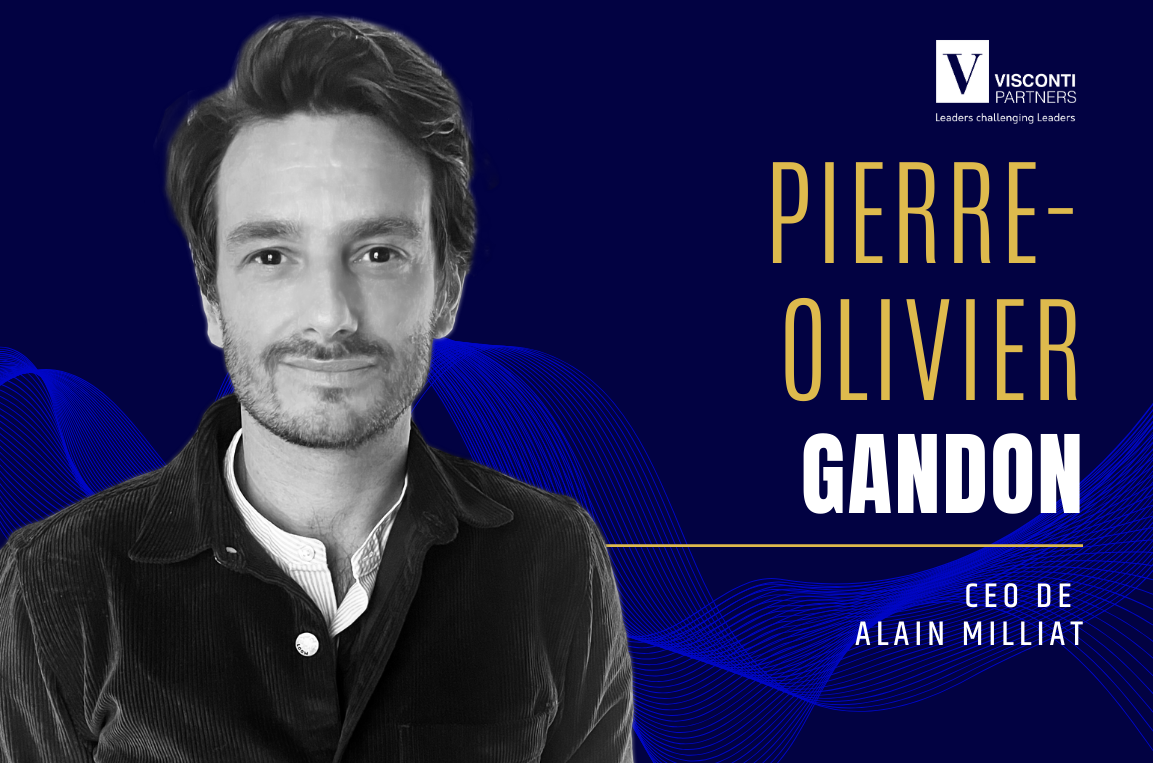
The guest: Pierre-Olivier Gandon, Managing Director of Maison Alain Milliat premium fruit juices and nectars positioned as gastronomic tasting products in conversation with Xavier Guérin, partner at VISCONTI Partners (Episode 49).
The episode opens on a question many leaders ask without answering clearly: what is a leadership team actually for? At Alain Milliat, it is neither a fixed ritual nor a rubber stamp for decisions already taken. Establishing it marked the shift from an intuitive governance, closely embodied by the founder, to a more structured one without losing the agility or the exactingness that define the house.
It is on his own posture that Pierre-Olivier Gandon is most direct. He shares what he has had to unlearn: not always wanting the last word; accepting not to add value where the collective can create more of it; letting less dominant voices come through; acknowledging fatigue, mental load, even vulnerability. He describes his role as that of a conductor, able to step back so the ensemble plays in tune, and lastingly.
He flags three pitfalls along the way that any leader will recognise:
The invisible indicators. A high-performing leadership team is recognisable by the energy in the room as the meeting ends, by the balance of speaking time, by members' ability to voice disagreement without fear, and by the way that energy then spreads through the organisation. None of these signals appears in a report.
The VISCONTI reading. The performance of the leadership team begins with the transformation of the leader. The mistake is to work on the forum before working on the posture. It is the reverse order that produces results.
The guest: Alexandre Simmler, co-leader of the family-owned SBM group close to 1,000 employees, €352m in revenue, operating across Europe and the United States in conversation with Pierre Ferrère (Episode 51).
He joined the business in 2003, starting on the ground before taking operational leadership of the group alongside his father, its founder. In 2016, the acquisition of Bayer's garden business in Europe and the United States changed the group's scale: from €25m to €250m in revenue, 150 employees joining, an entire organisational system to rebuild. A French SME became a structured international player within months.
And that is where the previous way of working reached its limit. Until then, decisions were taken within a restricted circle, carried by a strong entrepreneurial vision. Faced with a growing number of subsidiaries, international stakes and the need to secure the teams' future, intuitive governance no longer sufficed.
The response: establishing a board of directors including independent members. The effect is threefold leaving the inner circle behind, challenging decisions, structuring strategic thinking and the impact reaches beyond strategy: a leader more genuinely challenged on his convictions, teams reassured, a father-and-son relationship settled and better balanced.
His conviction: governance requires accepting to be challenged. The leader's role evolves it is no longer only about deciding, but about creating the conditions to decide better.
The coach's reading. Moving from intuitive functioning to structured governance does not mean losing your DNA. It is precisely what preserves it, strengthens it and makes it durable.
They fall, without forcing, into the six major challenges faced by leaders that VISCONTI Partners works on with its clients:
The Bpifrance figure takes on its full meaning here: 75% of leaders report having questioned the meaning of their commitment over the past twelve months, and among those describing themselves as very isolated, 46% rate their mental health as poor, against 17% across the whole sample. A mistake is never an isolated event; it thrives in an environment where nobody contradicts.
At VISCONTI Partners, we believe the greatest challenge facing today's leaders rests on a play on words that is not one: moving from Chief Executive Officer to Chief Engagement Officer.
That means shifting three notions:
With authenticity, courage and the capacity for hybridity. And remaining centred, in awareness and in action, on three objects: oneself, one's strategy, one's company culture.
Read the four accounts again through that lens. Nicolas Coudert opening the factory to families. Ariane Sanglé-Ferrière insisting that a video call will never replace human warmth. Pierre-Olivier Gandon stepping back so the ensemble plays in tune. Alexandre Simmler accepting contradiction from independent directors. None of these gestures belongs to control. All of them belong to engagement.
That is the purpose of our work: more than 300 CEOs, executive committees and boards supported every year, of whom more than 80% see strong growth in value and more than 70% an improvement in their life balance.
What are the most common mistakes a CEO makes? The accounts gathered in the VISCONTI Talks point to four recurring ones: underestimating the human factor when stepping into a role or taking over a business; believing there is time to learn; wanting the last word in the leadership team; and keeping governance within a restricted circle beyond the level of complexity it can absorb.
Why do leaders struggle to identify their own mistakes? Because isolation and cognitive biases the first two of the six major challenges faced by leaders reinforce one another. According to Bpifrance Le Lab (June 2026), 49% of SME and mid-cap leaders describe themselves as isolated, and 18% as very isolated. A leader with no one to contradict them has no correction mechanism.
How does an executive coach help correct them? Nicolas Coudert names three levers, tested in practice: a shared language, because his coach has entrepreneurial experience of his own; structured thinking, so as not to convince himself alone that his decisions are the right ones; and an entrepreneurial discipline that imposes what is scarcest time and perspective.
Where can I listen to the VISCONTI Talks? The podcast VISCONTI Talks Leader Trajectories is available on our podcast channel, as well as on Spotify, Apple Podcasts and Deezer.
Visconti Partners presents its advice, inspiration, and case studies to help you unlock your potential and that of your business.
View all articles

What keeps a company standing isn't always what you'd expect. A cross-reading of biology and management on executive robustness.
%20(2)%20(2).png)


In this new issue of VISCONTI TALKS, Benoît QUIGNARD, director and coach at VISCONTI, welcomes Valérie DAVID, Director of Sustainable Development and Transversal Innovation at the EIFFAGE Group. Reaffirm its leadership role in its environment and give meaning to its core business...
.png)