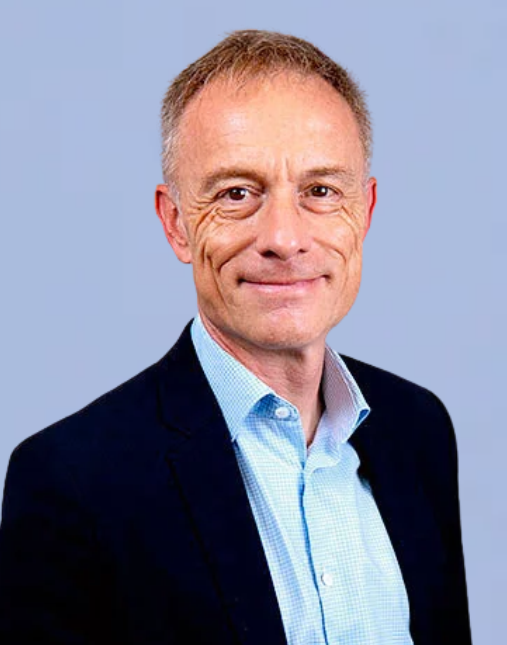
For almost three years, France's building sector has been caught in a crisis that shows no sign of ending. Sibylle Daunis-Opfermann runs La Plateforme du Bâtiment, a Saint-Gobain brand with 2,200 employees, and she has had to accept that this crisis is now the norm. In this episode of Visconti Talks, she tells Jean-Pascal Mermet, a partner at VISCONTI, how she holds her course: tell the truth early, protect the team's energy, and bury your ego "at the bottom of the garden".
Who is Sibylle Daunis-Opfermann?
Sibylle Daunis-Opfermann has been CEO of La Plateforme du Bâtiment, a Saint-Gobain brand, for two and a half years. The 28-year-old business serves trade professionals only: craftspeople, sole traders and small building firms. Before moving into distribution, she spent 17 years at PUM, another Saint-Gobain brand in the builders' merchant trade, and seven years in general management.
Before taking up the role, almost before seeing the P&L, she spent two months in the network alongside teams who open at 6 a.m. and close at 8 p.m. It is a company ritual. It gave her a sharp, ground-level view of the business from her very first day.
What is permacrisis?
A permacrisis is a long, insidious crisis that drags on, flares up again and deepens instead of fading. For Sibylle Daunis-Opfermann, the cycle began in 2020 with Covid. By 2026, that means six years of disruption, the last three even more complex, shaken by political and geopolitical twists.
She compares it to the climate: cycles that speed up, and events that grow more intense. Jean-Pascal Mermet points out that Christopher Guérin, former head of Nexans, describes the same thing in his book Pour aller dans le bon sens: permacrisis is becoming the norm, and leadership has to adapt to it.
"What does a long permacrisis look like? It looks like fatigue." — Sibylle Daunis-Opfermann
The building-sector crisis: what has changed for customers
Customer satisfaction no longer guarantees loyalty. That is her first observation. The renovation market, usually resilient, has fallen over the past three years, for the first time in decades. Tradespeople are seeing their order books shrink and are hit by cash-flow shocks from their own clients. Some walk in one morning and say they have no work left for their teams. She had never seen that before.
Three deep shifts follow:
- Customers are restructuring. Many small contractors have gone back to self-employment, or moved their staff onto self-employed status. They now work as networks rather than as established firms.
- Price has become central. After the post-Covid inflation years, tradespeople shop around and buy from several suppliers, where a single point of contact used to save them time.
- Competition is intensifying. DIY superstores, online pure players and new suppliers are gaining ground, while the customer base is also changing generation.
Short term, long term: how a leader holds both in a crisis
In a long crisis, you have to refocus on the short term without giving up the vision that will keep the company competitive and distinctive tomorrow. For Sibylle Daunis-Opfermann, it all starts with collective awareness, which then makes it possible to explain decisions.
So the executive committee spends more time on the business, on making sure everyone is aligned, and on acting as one team, moving past the divide between the store network and head-office support teams. Alongside this, the company has dedicated people in its support teams to the long term, on four or five major strategic projects. Their profile: people who can run a project, question the front line, then build. Some were hired specifically for this, bringing "a fresh pair of eyes".
When she arrived, she also launched a ten-year vision. Every employee was consulted, and the work was then taken further with the top 150 managers.
How do you tell your teams the crisis is here to stay?
The hardest moment, for Sibylle Daunis-Opfermann, was realising the crisis would not be short, and then saying so. For two years, she had hoped for a quick way out. Even energy-efficient renovation, a strategic priority for the company and for decarbonising buildings, has lost momentum as the legislation keeps changing.
She had to change her message: stop holding out the promise of clearer skies, and explain that what had made the company successful would not be enough for what comes next. The challenge is doing that without discouraging people: telling employees that who they are is remarkable, and that they still need to go further for the next 30 years.
"The first piece of advice, and probably the most important, is to tell your organisation the truth early."
From cascading to ownership: getting managers to carry the message
A rational, well-rehearsed speech is not enough to move an organisation. That is the conviction Sibylle Daunis-Opfermann says she had to let go of. Her teams agreed with her, but when they had to explain the message to their own teams, it did not land: it had been cascaded, not owned.
Managers therefore need to take the time to absorb the message: "embrace it, chew it over, digest it and give it back". For operational managers used to action, that time feels wasted because nothing gets produced. Yet in her view it is one of the key lessons in turning an organisation around.
Culture and strategy: the "second leg"
Culture eats strategy if you leave it off the roadmap. That is her answer to the line attributed to Peter Drucker, "culture eats strategy for breakfast". La Plateforme du Bâtiment's culture rests on what the company calls the "symmetry of attention": take care of your people, they will take care of your customers, and results will follow.
That strength has its blind spots: avoiding confrontation, measuring results less, diluting accountability within the group. "Everyone is to blame and no one is responsible," she sums up. Hence the "second leg" to strengthen: performance, a culture of objectives and individual accountability. "If you want to run, you need two legs."
The executive committee in a crisis: debate first, then commit
The executive committee's job is not to agree from the outset. It is to debate rigorously, then loyally carry the direction chosen. Sibylle Daunis-Opfermann has brought very diverse profiles onto her committee, and takes care not to sand them down until they resemble everyone else. The committee works on listening and on "yes, and" rather than "yes, but", building on each other's ideas so that debate leads to decisions.
Its most distinctive tool is the "META": a permanent guest, the head of transformation, sits in on every committee meeting. At the end, she reports back on whether the group met its objectives, in substance and in style, and challenges how the committee works. A committee member used to play this role, but "we tend to be a bit too nice to each other". Now, "sometimes it ruffles feathers". The precondition, in the words of one of her former bosses: bury your ego at the bottom of the garden.
Time on the ground: removing friction to engage people
The rule is simple: the whole executive committee must be in a store every month. Each member brings their expertise, hears what has been getting in the way, and picks up the collective wins to share back at head office. Two employee surveys a year complete the picture, with results broken down store by store.
When she is under pressure, she goes into a store herself to recharge. She listens to people's wins, their pride and their difficulties, and sorts out two or three gaps between head office and the network. Time on the ground also helps her adjust the pace: "I can race ahead on my own," she admits. For Jean-Pascal Mermet, a leader's role comes down to three verbs: shed light on the purpose, remove the obstacles, engage.
How can a leader protect their energy in a long crisis?
"You don't manage a three-year permacrisis the way you manage a three-week crisis." Protecting her own energy and her committee's is therefore Sibylle Daunis-Opfermann's second piece of advice. She relies on three levers:
- Pick your battles. Last year, the company chose eight strategic priorities and focused all its attention on them.
- Keep white space in your diary. She was once told to keep 20% of her time free; 18% is still acceptable, but at 15% things start to slip.
- Know what keeps you going. She kept up her sport throughout: "you have to know what you're made of".
The coach's take
For Jean-Pascal Mermet, partner at VISCONTI, three pieces of advice stand out from the conversation:
- Build collective awareness of how much the short term matters next to the long term, and protect the energy of the committee, the CEO and employees through clear prioritisation.
- Bury your ego at the bottom of the garden, and spend time on the ground with your people.
- Accept that permacrisis is the new normal, and say so to the organisation.
He also recalls Carl Jung's words: "becoming aware is a creative act". In other words, moving from autopilot to adaptation.
Key takeaways
- Tell the truth early, without softening the blow: the shock is what sets things in motion.
- Dedicate people to the long term, so the executive committee can focus on what is urgent.
- Get managers to own the message, not just pass it on.
- Strengthen a results culture without losing a relationship culture.
- Let the committee debate, then ask it to carry the decision loyally.
- Protect your energy: eight priorities, 20% free time in your diary, time on the ground, and sport.
FAQ
What does permacrisis mean for a business? It is a long crisis that drags on, flares up and deepens instead of fading. For Sibylle Daunis-Opfermann, it means you stop waiting for the way out and accept it as the new normal.
How do you lead a company through a long crisis? By holding the short term (business, alignment, team) and the long term (vision, competitiveness, differentiation) together. La Plateforme du Bâtiment dedicates people to four or five long-term projects.
How do you tell your teams a crisis will last without discouraging them? By telling the truth early while recognising what the teams have achieved. The message: who we are is remarkable, but we need to go further.
How do you re-engage teams worn down by a crisis? By being present on the ground, fixing day-to-day friction, celebrating successes and giving managers time to make the meaning of decisions their own. At La Plateforme du Bâtiment, the whole executive committee visits a store every month.
What is the executive committee's role in a crisis? To debate rigorously, then loyally carry the decision. A permanent observer, the "META", helps the committee say what really needs saying.
How can a leader protect their energy? By picking their battles, keeping around 20% of their diary free and knowing what keeps them going, whether that is sport or time on the ground.
Talk to a VISCONTI coach — Leading your executive committee through a long crisis? Our coaches, all former CEOs and senior executives, can help.

Jean-Pascal MERMET
"Everyone takes the limits of their own field of vision for the limits of the world." Arthur Schopenhauer