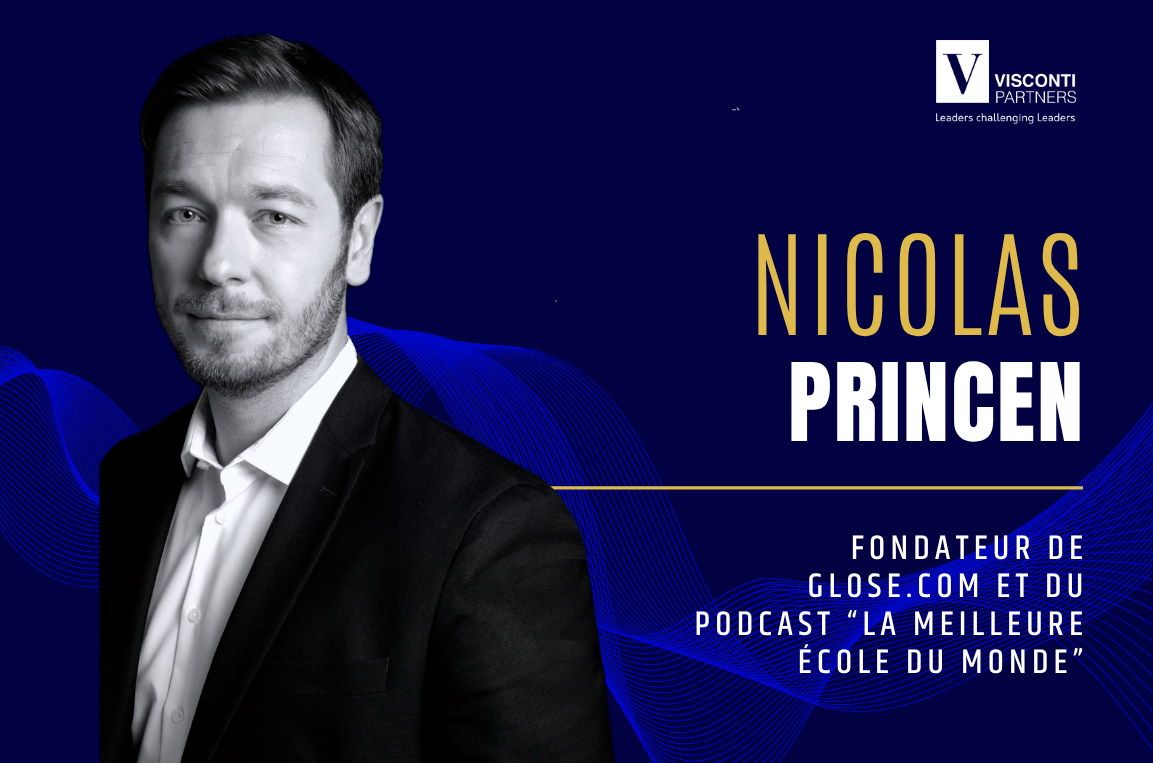
At 23, he joined the Élysée. At 28, he started all over again, in a cellar, with interns. In this episode of Visconti Talks, Hubert Reynier, founder of VISCONTI Partners, welcomes Nicolas Princen. A conversation about ego, humility and the courage to start from scratch.
Who is Nicolas Princen?
Nicolas Princen sees himself first and foremost as an entrepreneur. A graduate of the École Normale Supérieure and HEC, he brings together two cultures: philosophy and business.
In 2007, while still a student, he joined the presidential campaign. He then followed the team to the Élysée and stayed for five years, as technical adviser for the digital economy. The role did not exist. He proposed it, then created it.
In that capacity, he took part in setting up France's National Digital Council (Conseil national du numérique) in 2011 and in organising the e-G8, which brought heads of state and global tech leaders together for the first time.
How do you move from public to private?
In 2012, the campaign was lost. Offers poured in: at the time, everyone was looking for a chief digital officer. Nicolas Princen turned them down. He chose to become an entrepreneur.
"It's better to detox from politics before becoming an entrepreneur. It took me about a year."
He started from a simple question: how can digital technology serve reading, rather than threaten it? The answer was Glose. Founded in 2014, the platform makes reading collaborative: readers share notes and comments in the margins of books.
American universities adopted it for their case studies. According to law firm Orrick, Glose then reached more than a million readers and supplied more than 25 universities.
In January 2021, Medium, the platform founded by Twitter co-founder Ev Williams, acquired Glose. Nicolas Princen took charge of Medium Books, reports Siècle Digital. He worked there for three years, between Paris and San Francisco.
This move from public to private echoes a reality VISCONTI knows well: leaders from the public and semi-public sector often face the same questions of stance and legitimacy.
Starting from scratch: why ego is the first obstacle
For Nicolas Princen, the decisive quality is not vision. It is adjusting one's ego.
"Knowing how to hand back your medal and head back into battle."
Starting from scratch means accepting to become a beginner again. Asking for advice. Talking to a great many people. Stepping down from the pedestal your previous position had placed you on.
Hubert Reynier sums it up with an image: writing a good first novel does not mean you will write a good second one. Past success guarantees nothing. It can even hold you back.
The creative revolutionary: the profile of "0 to 1" founders
During the conversation, Hubert Reynier links Nicolas Princen to a profile common among founders: the creative revolutionary. Someone who finds an angle, spots a gap in the market and quickly establishes a concept.
Nicolas Princen borrows Peter Thiel's terminology: he is more "0 to 1" than "1 to 1000". He likes to get things started. Managing them afterwards interests him less. The flip side: you always start somewhat from scratch, and it does not necessarily compound.
This kind of talent assessment lies at the heart of the VISCONTI Assessment Center.
Emulation or jealousy: which kind of competition fuels a leader?
Competition can nourish or drain. It all depends on which way it leans.
Emulation means looking at a successful entrepreneur and asking what they have understood. Jealousy, on the other hand, is an energy trap. "You learn nothing from jealousy," observes Nicolas Princen. A leader must learn very early to turn one into the other.
Entrepreneurship for the common good: tech, education and a leader's commitment
Since 2024, Nicolas Princen has organised his time around three activities, which he sees as a continuum:
- Technological innovation: investor and co-founder of projects, against the backdrop of the AI revolution.
- Writing: his first book, Leçons de courage : les héros de la France libre ("Lessons in Courage: the Heroes of Free France"), published by Fayard in 2026. Writing it, finding a publisher, championing it in bookshops: for him, it is a complete entrepreneurial project.
- Public engagement: his podcast and YouTube channel, La Meilleure École du Monde ("The Best School in the World"), gather the best grassroots practices for schools, ahead of the 2027 debate.
His method is an entrepreneur's: start from the facts, listen to people on the ground, spread what works.
1% ideas, 99% execution: what the State can learn from business
Nicolas Princen compares the State to a company in difficulty. It would need to restructure and pivot at the same time: for instance, shifting from a curative healthcare system to a preventive one.
The main obstacle? A culture of blockage. His answer: rather than imposing everything from the top, identify and scale what already works on the ground. Companies know how to nurture their best practices. The State, far less so.
Hubert Reynier draws a parallel with transformation projects in business: without explanation and repetition, an announced measure remains a dead letter. That is the whole challenge of change management, as the episode with Nicolas Coudert already showed.
The coach's view: humility, sacrifice, legacy
At the end of the episode, Hubert Reynier draws out three notions for every leader:
- Humility: resetting the counter to zero, whatever your past successes.
- Sacrifice: entering public life comes at a cost, privacy, criticism, the risk of failure. It must be weighed up before taking the plunge.
- Legacy: leaving a positive and lasting mark, through a company, a book or public action.
One detail is worth highlighting: Nicolas Princen reveals that he was coached by Hubert Reynier, notably to organise his time and his diary. A concrete example of what executive coaching can achieve.
Key takeaways
- Starting from scratch is a choice, not an accident.
- A well-adjusted ego is a leadership skill.
- A transformation succeeds through the ground, explanation and execution.
An episode for leaders in transition, founders and anyone hesitating to leave an established position.
FAQ
Who is Nicolas Princen? An entrepreneur, former technical adviser for the digital economy at the Élysée (2007–2012), founder of Glose, acquired by Medium in 2021, and author of Leçons de courage (Fayard, 2026).
How do you start from scratch after a success? According to Nicolas Princen, by adjusting your ego, becoming a learner again and focusing on the future rather than the past.
How do you make a successful move from public to private? By accepting the loss of a position's prestige, starting again with few resources and seeking plenty of advice.
What is a "creative revolutionary" profile? A leader who identifies a gap in a market and quickly establishes a new concept, offer or organisation.
Why seek support during a career transition? A transition calls into question your stance, your legitimacy and how you organise your time. An executive coach helps you step back on all three.
Going through a change of role or sector? Talk to a VISCONTI coach.

Hubert REYNIER
« Those who do are right »